
Choose the Right Must Power Inverter Capacity for Your Home
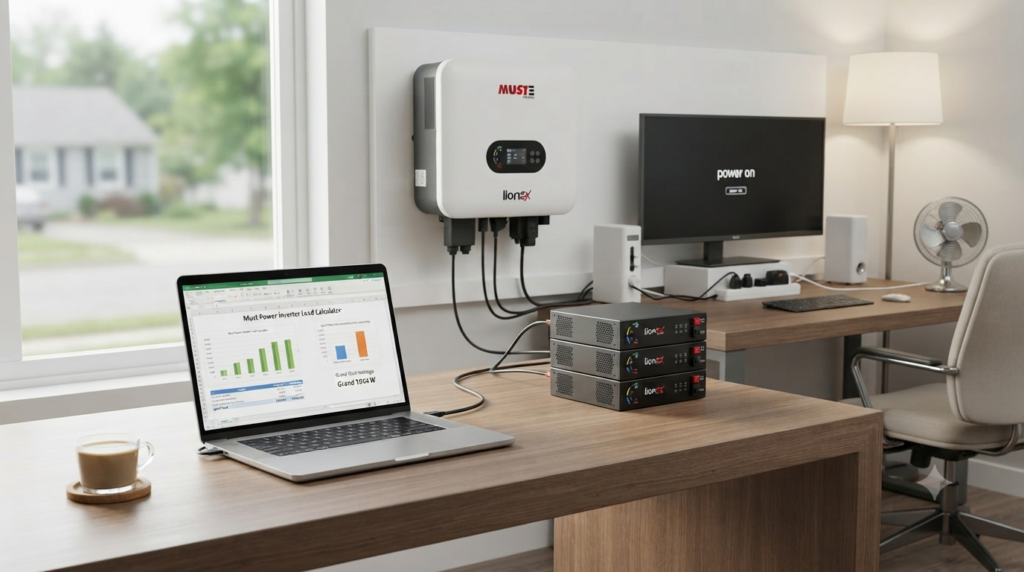
Investing in a solar and backup power system is one of the smartest decisions you can make for your home or office. It ensures business continuity, protects your family from frustrating outages, and drastically cuts down electricity bills. However, the most critical step in this process isn’t choosing the brand or the panel type—it is calculating and selecting the correct inverter capacity.
If your inverter capacity is too small, it will trip constantly under heavy loads or fail to start high-surge appliances. If it is too large, you end up wasting money on capacity you don’t need, often leading to inefficient operation at low loads.
Here is a practical, step-by-step guide to calculating your load and choosing the right Must Power inverter for your space.
Step 1: List Your Essential Appliances
Before looking at any technical specifications, you need to know exactly what appliances you want your inverter to run simultaneously during a power outage.
Create a simple inventory table dividing your appliances into two categories:
-
Home Essentials: Ceiling fans, LED lights, Wi-Fi router, refrigerator, television, and water pumps. (Air conditioners are optional depending on your system size).
-
Office Essentials: Computers/laptops, servers, printers, lighting, ceiling fans, and security systems.
Step 2: Determine Starting vs. Running Wattage
This is where many people make mistakes. Appliances fall into two groups based on how they draw power:
-
Resistive Loads (Constant Power): Devices like LED lights, televisions, and ceiling fans consume the same amount of power continuously. Their running wattage equals their starting wattage.
-
Inductive Loads (Surge Power): Devices equipped with electric motors—such as refrigerators, water pumps, and air conditioners—require a massive “surge” of power for just a second or two to start up, often 2 to 3 times their normal running wattage.
Example: A standard refrigerator might only use 200 to 300 running watts, but it can require up to 1,200 watts momentarily to kick-start the compressor. Your Must Power inverter must be capable of handling this surge capacity.
Step 3: Calculate Your Total Load (Watts)
Add up the running wattage of all the appliances you plan to run at the same time. Here is a quick reference for average appliance wattages:
-
LED Light Bulb: 10W – 15W
-
Ceiling Fan: 75W – 80W
-
Inverter Refrigerator: 200W – 300W (Running)
-
LED TV & Router: 100W – 150W
-
1.5 Ton Inverter AC: 1,200W – 1,500W
-
Office Desktop Computer: 150W – 250W
Sample Home Calculation:
-
4 Ceiling Fans = 320W
-
6 LED Lights = 60W
-
1 Refrigerator = 250W
-
1 TV & Router = 150W
-
Total Running Load = 780 Watts
Step 4: Apply the Safety Margin (The 25% Rule)
Never buy an inverter that matches your exact total load. Running an inverter at 100% capacity continuously strains the internal components, generates excess heat, and drastically reduces its lifespan.
Best Practice: Multiply your total running wattage by 1.25 (adding a 25% safety buffer). This ensures your system stays cool, runs efficiently, and accommodates minor unexpected loads or motor surges.
Calculation: 780W × 1.25 = 975W
Step 5: Convert Watts to KVA (Kilovolt-Amperes)
Inverters are typically rated in VA or KVA (Apparent Power) rather than just Watts (Real Power), due to something called the Power Factor (usually around 0.8 for standard systems).
To convert your required Watts into the correct KVA inverter size, divide your final wattage by 800 (or multiply by 1.25):
Calculation: 975W / 0.8 = 1,218VA (or roughly a 1.2KVA to 1.5KVA inverter for a basic light-and-fan setup).
If you are running heavy air conditioning or heavy office machinery totaling around 3,000W to 4,000W, you would look at robust 3KW to 5KW Must Power hybrid inverters.
Why Choose Must Power Inverters?
Once you have calculated your capacity, choosing the right hardware brand makes all the difference. Must Power inverters are engineered for reliability, featuring:
-
Pure Sine Wave Output: Delivers clean, stable electricity identical to grid power, keeping sensitive electronics, laptops, and refrigerators completely safe from buzzing or damage.
-
High Surge Capacity: Seamlessly handles motor startups without tripping.
-
Smart MPPT Solar Charge Controllers: Maximizes power harvest from your solar panels, charging your battery bank faster and reducing grid dependency.
Conclusion
Getting the right inverter capacity is a balancing act between your daily comfort, appliance requirements, and budget. Taking ten minutes to accurately tally your wattage prevents system overload and guarantees uninterrupted performance when you need it most.
Unsure about your exact load calculations? Consult with our expert team at Must Power Energy, and we will help you configure the ideal solar setup tailored specifically to your home or office.


