Lead-Acid vs. Must Power Lithium Batteries: Which is Best for Your Home
When configuring a backup or solar power system in Pakistan, choosing the right inverter is only half the battle. The true heart of your energy system—the component that dictates how long your lights stay on, how much you spend, and how often you deal with replacements—is your battery bank.
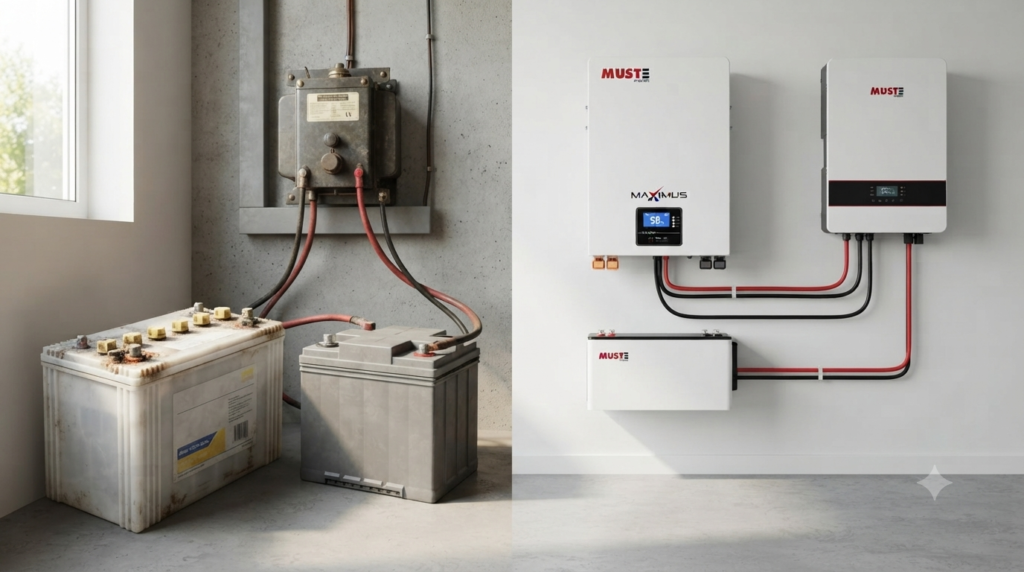
For years, traditional tubular lead-acid batteries have been the default choice across Pakistani households. However, with advancements in technology and frequent grid fluctuations, lithium iron phosphate (LiFePO4) batteries—specifically advanced Must Power lithium solutions—have emerged as the gold standard.
If you are trying to decide which battery technology deserves a spot in your home, this comprehensive comparison breaks down lifespan, performance, safety, and long-term cost.
1. Lifespan and Durability
The most striking difference between the two technologies is how long they last before needing a replacement.
-
Lead-Acid Batteries: Traditional batteries rely on a chemical reaction involving lead plates and liquid acid. They typically offer a lifespan of 2 to 3 years (roughly 300 to 500 charge cycles at a 50% depth of discharge). In Pakistan’s intense summer heat and frequent load-shedding cycles, lead-acid batteries degrade even faster.
-
Must Power Lithium Batteries: Built with advanced Lithium Iron Phosphate (LiFePO4) chemistry, Must Power lithium batteries boast an impressive lifespan of 10 to 15 years (delivering anywhere from 3,000 to 6,000+ cycles).
Verdict: While a lead-acid battery requires frequent replacements every few years, a single Must Power lithium battery can outlast three to four sets of traditional batteries.
2. Depth of Discharge (DoD) and Usable Capacity
Depth of discharge refers to how much energy you can safely drain from a battery before it needs to be recharged.
-
Lead-Acid Batteries: You can only use about 50% of a lead-acid battery’s total capacity without severely damaging its internal plates. If you drain a 200Ah lead-acid battery completely, you shorten its life drastically.
-
Must Power Lithium Batteries: You can safely utilize 80% to 90% (and sometimes up to 95%) of a Must Power lithium battery’s total capacity without compromising its lifespan.
Verdict: A 200Ah lithium battery gives you significantly more usable daily power than a 200Ah lead-acid battery, meaning you can run more appliances for longer during extended power outages.
3. Charging Speed and Efficiency
In areas with erratic grid schedules and limited sunlight windows, how fast your battery charges is critical.
-
Lead-Acid Batteries: They accept charge relatively slowly due to internal resistance. Trying to force a rapid charge generates excessive heat, which ruins the battery. They also suffer from low round-trip efficiency (around 70–80%), meaning energy is lost as heat during charging and discharging.
-
Must Power Lithium Batteries: Lithium batteries support ultra-fast charging. They can go from empty to fully charged in a fraction of the time, making the most of short grid availability or peak midday solar generation. Their efficiency hovers around 95% or higher.
Verdict: Must Power lithium batteries store solar energy much faster and waste far less power in the process.
4. Maintenance and Safety
-
Lead-Acid Batteries: They are high-maintenance. Users must frequently check water/acid levels, top them up with distilled water, clean corrosive sulfate buildup off the terminals, and ensure the room is heavily ventilated to release toxic, explosive hydrogen gas during charging.
-
Must Power Lithium Batteries: They are completely maintenance-free. Sealed in a compact, modular casing, they feature an advanced Battery Management System (BMS) that actively monitors voltage, temperature, and current to protect against overcharging, short-circuiting, and overheating.
Verdict: Lithium systems offer a true “install-and-forget” user experience with superior safety protocols.
5. Cost Analysis: Short-Term vs. Long-Term
It is no secret that upfront pricing is the main hurdle for many buyers.
-
Lead-Acid: Low initial purchasing cost. It feels lighter on the wallet today, but factoring in replacements every 2–3 years, constant maintenance, and wasted electricity makes it expensive over a 10-year horizon.
-
Must Power Lithium: Higher initial investment. However, because it lasts a decade or longer without replacement and delivers maximum energy efficiency, the total cost of ownership over time is significantly lower.
Summary Comparison Table
| Feature | Traditional Lead-Acid | Must Power Lithium |
|---|---|---|
| Lifespan | 2 – 3 Years | 10 – 15 Years |
| Usable Capacity (DoD) | 50% | 80% – 90% |
| Maintenance | Regular water top-ups & cleaning | 100% Maintenance-Free |
| Charging Speed | Slow | Ultra-Fast |
| Built-in Smart BMS | No | Yes |
| Long-Term Value | Low | High |
Final Verdict: Which is Best for Your Home in Pakistan?
If you are on an extremely tight short-term budget and only need a temporary backup solution, lead-acid batteries remain an option.
However, if you want uncompromised reliability, peace of mind during grueling summer load-shedding, faster charging, zero maintenance, and a system that pays for itself over a decade of trouble-free operation, upgrading to a Must Power Lithium Battery is undeniably the smartest investment for your home.
Ready to make the switch to next-generation energy storage? Explore our range of high-performance Must Power lithium solutions or speak with our energy experts at Must Power Energy today to find the perfect configuration for your household.